Pages

Showing posts with label Outdoor Practitioners. Show all posts

Jul 20, 2016

Pokemon Go, as an Approach to Tourism and Politics in Albania | In search of missing pieces


Granted I don't play, but the more I read and learn about PokemonGo the more I find it curiously similar to many state-centric campaigns in Albania, especially when it comes to tourism and politics - how these campaigns are run, consequently won and ultimately deemed successful. Actually, the same can be said of any other major decision-making (reforms and rulings) event that has to do with a public audience/participant, place, and resources. 

It is curious indeed that they all propose an 'alternat(e/ive)' reality while leaving the existing one in a much worse condition that they found it. To most skeptics, this is a temporary perverse fantasy, but we've come to find out it isn't going anywhere. To the players and enthusiasts, it is a game of obsession, an addiction that has willingly made them both victim and perpetrator. To the enablers on the other hand, it is a global toolbox, a mass-marketing automation that marks progress, even though not necessarily equality or justice. In short, a brave new world, an augmented reality that promises to infuse the actual with the virtual, the real and the unreal, in a life and mind-blowing existence of continuous interaction. A holistic presence that vows to enhance the quality of life as we know it. A campaign built on trust or better yet stolen trust - whatever is promised in the ether, will be materialized in the physical realm. A public augmented to publicity. Hear, hear, for a better, fuller and happier life - lived.

Unfortunately, as we continue to bear witness to what is happening every single day, we have become quicker to react to (and forget) moments that shock - a chaotic recurrence of senseless acts, speeches and allegiances that buildup and blowup tirelessly on both social media feeds and our urban streets. What are the human ramifications of such augmentation then? They're not only seen anymore, they're felt. The world has become simultaneously better connected while its privacy better invaded. We are fuller of dis, mis, in and form-ation. Fuller of expression and hate. Fuller of all sorts of freedoms. Fuller of diversity and division. Fuller of blatant knowledge and harassing ignorance. Fuller of (market) makers, breakers, and shakers. Fuller of things to do and time wasted. How much happier though? Well, the promise of the fantastic (of the fantastically fabricated) - that better reality - is cashing in, to the fullest. It is colonizing the real world (if it hasn't already). It has made it a commodity. To live has become a commodity. 

The public has become (imho, not even properly) incentivized to catch imaginary monsters, landmarks and natural sites, thus having willingly and quite excitedly relinquish their physical awareness of actually identifying and hunting the real-life monsters. Since this is a thing now, as evasive as it is pervasive (even if not entirely and not always, but still way too often) then we're way off base calling it an 'augmented' anything, on the contrary, it is a redacted something, our reality made invisible or hypervisible (always blurred) for reasons above our ask grade - only to reappear virtually, changed, reconfigured, for the same classified reasons. If until recently we considered the image to represent or interpret the actual thing, now we're in it, experiencing it in real-time. I don't know if experiencing it virtually/digitally is better or worse, or even similar to imagining or dreaming it, but soon we'll feel nostalgic about those dream-ful/less nights when we were glad to wake up and find out that whatever we weren't able to remember anymore didn't actually happen and our bodies were in a a still position, asleep in bed or on the couch in front of the TV - distanced from an unconsciousness we could hid well, escape from and that we couldn't completely understand. This distance between the real and the unreal, at least physically speaking, made us aware of our bearings, alert of how far to reach and how close to guard our presence. Scale and sensibility. What once was a reality imagined, it has now metamorphosed into an image realized.
 
(videodrome, cronenberg) via GIPHY

Re-cognition patterns of understanding, behavior, language, meaning, memory and belonging are being re-shuffled, re-prioritized, re-valued - colonized and commodified. We are now swallowed in by the screen, voluntarily no less. Instead of using technology to augment our presence, awareness and sense of place - we've rendered our-selves as avatars, in pixels instead of cells, a specter of dematerialization and rematerialization between place and interface, presence and metadata, this and that. Bodies in space feel isolated, excluded the more they are connected - unable to interact seamlessly and prone to accidents, our deduction abilities stalling, cryptic, wasted. The promised 'enhancement' is being felt in the incompatibilities of the two realities, and not in their collaboration. We've got a long way to go. We are being exploited, voluntarily. 

The fear of not measuring up to real-life humanity, the banality of (what we actually dread just as much) the everyday life, has made this game, these campaigns and all their cohorts (including media) result to an 'alternat(e/ive)' reality, that is not just an image or propaganda, but a lived slogan. A promise is a promise is a promise is a promise is a ... lie is a life. It hasn't quite augmented the goods, only the bads. It has only enhanced the real by providing a brief escape into the virtual, only to bring us right back to the terrors, trials, and trivial gravity of this world. 

The question then, is not just what are the physical ramifications of such an alternate everyday, but how do we deal with them? What are the consequences of designing everything without taking into account the human factor: spatial behavior and mental state, cognition and hormones, and everything else that overly-designed environments tend to kill?

So, when you decide to play Pokemon, like or react to a campaign image or video on social media, think about these things. What we ought to believe and what we do indeed believe in are constellations apart. Yes, the truth is out there, but so are the stars and so is the abyss. Plenty of room to get lost. Again, scale and sensibility. 

Lastly, I'd like to leave you and end these scattered thoughts with this quote from The Shining: "Sometimes human places, create inhuman monsters." Plenty to think about.


***********************************************************


Jul 2, 2016

A new aesthetic of enjoyment | In search of missing pieces

Summertime! The perfect season to revisit Lefevbre's beach, Lippard's beaten track, and Huizinga's play while drawing conclusions on the new Albanian aesthetic of the park, the playground and the beach. All, spaces of leisure and enjoyment -- of differences -- departures dominated by the aesthetics of tourism, contaminated by the consumption of nature, and cultured in the spectacle of bodies.

Conclusions drawn. Literally!

Following Lefebvre's The Production of Space (excerpts below), how does this departure from the everyday reality produce the illusion of spaces for leisure and enjoyment in Albania?

***
A moment comes when people in general leave the space of consumption, which coincides with the historical locations of capital accumulation, with the space of production, and with the space that is produced; this is the space of the market, the space through which flows follow their paths, the space which the state controls - a space, therefore, that is strictly quantified. When people leave this space, they move towards the consumption of space (an unproductive form of consumption). This moment is the moment of departure — the moment of people's holidays, formerly a contingent but now a necessary moment. When this moment arrives, 'people' demand a qualitative space. The qualities they seek have names: sun, snow, sea. Whether these are natural or simulated matters little. Neither spectacle nor mere signs are acceptable. What is wanted is materiality and naturalness as such, rediscovered in their (apparent or real) immediacy. Ancient names, and eternal - and allegedly natural — qualities. Thus the quality and the use of space retrieve their ascendancy — but only up to a point. In empirical terms, what this means is that neocapitalism and neo-imperialism share hegemony over a subordinated space split into two kinds of regions: regions exploited for the purpose of and by means of production (of consumer goods), and regions exploited for the purpose of and by means of the consumption of space. Tourism and leisure become major areas of investment and profitability, adding their weight to the construction sector, to property speculation, to generalized urbanization (not to mention the integration into capitalism of agriculture, food production, etc.). No sooner does the Mediterranean coast become a space offering leisure activities to industrial Europe than industry arrives there; but nostalgia for towns dedicated to leisure, spread out in the sunshine, continues to haunt the urbanite of the super-industrialized regions. Thus the contradictions become more acute — and the urbanites continue to clamour for a certain 'quality of space'. 

In the areas set aside for leisure, the body regains a certain right to use, a right which is half imaginary and half real, and which does not go beyond an illusory 'culture of the body', an imitation of natural life. Nevertheless, even a reinstatement of the body's rights that remains unfulfilled effectively calls for a corresponding restoration of desire and pleasure. The fact is that consumption satisfies needs, and that leisure and desire, even if they are united only in a representation of space (in which everyday life is put in brackets and temporarily replaced by a different, richer, simpler and more normal life), are indeed brought into conjunction; consequently, needs and desires come into opposition with each other. Specific needs have specific objects. Desire, on the other hand, has no particular object, except for a space where it has full play: a beach, a place of festivity, the space of the dream. (353) 
***
Typically, the identification of sex and sexuality, of pleasure and physical gratification, with 'leisure' occurs in places specially designated for the purpose — in holiday resorts or villages, on ski slopes or sundrenched beaches. Such leisure spaces become eroticized, as in the case of city neighbourhoods given over to nightlife, to the illusion of festivity. Like play, Eros is at once consumer and consumed. Is this done by means of signs? Yes. By means of spectacles? Certainly. Abstract space is doubly castrating: it isolates the phallus, projecting it into a realm outside the body, then fixes it in space (verticality) and brings it under the surveillance of the eye. The visual and the discursive are buttressed (or contextualized) in the world of signs. Is this because of what Schelsky calls 'the iron law of commercial terrorism'? Undoubtedly — but it is also, and most of all, because of the process of localization, because of the fragmentation and specialization of space within a form that is nevertheless homogeneous overall. The final stage of the body's abstraction is its (functional) fragmentation and localization.

The oddness of this space, then, is that it is at once homogeneous and compartmentalized. It is also simultaneously limpid and deceptive; in short, it is fraudulent. Falsely true — 'sincere', so to speak; not the object of a false consciousness, but rather the locus and medium of the generation (or production) of false consciousness. Appropriation, which in any case, even if it is concrete and effective, ought to be symbolizable - ought, that is, to give rise to symbols that present it, that render it present - finds itself signified in this space, and hence rendered illusory. (310) 

***
The dialectical link (meaning the contradiction within a unity) between need and desire thus generates fresh contradictions — notably that between liberation and repression. Even though it is true that these dialectical processes have the middle classes as their only foundation, their only vehicle, and that these middle classes offer models of consumption to the so-called lower classes, in this case such mimesis may, under the pressure of the contradiction in question, be an effective stimulus. A passionate struggle takes place in art, and within artists themselves, the essential character of which the protagonists fail to recognize (it is in fact class struggle!): the struggle between body and non-body, between signs of the body and signs of non-body.

Mental space - the space of reductions, of force and repression, of manipulation and co-optation, the destroyer of nature and of the body - is quite unable to neutralize the enemy within its gates. Far from it: it actually encourages that enemy, actually helps to revive it. Which takes us far further than the often-mentioned contradictions between aesthetics and rationalism. (353-4)
***
Such spaces appear on first inspection to have escaped the control of the established order, and thus, inasmuch as they are spaces of play, to constitute a vast 'counter-space'. This is a complete illusion. The case against leisure is quite simply closed - and the verdict is irreversible: leisure is as alienated and alienating as labour; as much an agent of co-optation as it is itself co-opted; and both an assimilative and an assimilated part of the 'system' (mode of production). Once a conquest of the working class, in the shape of paid days' off, holidays, weekends, and so on, leisure has been transformed into an industry, into a victory of neocapitalism and an extension of bourgeois hegemony to the whole of space.

As an extension of dominated space, leisure spaces are arranged at once functionally and hierarchically. They serve the reproduction of production relations. Space thus controlled and managed constrains in specific ways, imposing its own rituals and gestures (such as tanning), discursive forms (what should be said or not said), and even models and modulations in space (hotels, chalets — the emphasis being on private life, on the genital order of the family). Hence this space too is made up of 'boxes for living in', of identical 'plans' piled one on top of another or jammed next to one another in rows. Yet, at the same time, the body takes its revenge - or at least calls for revenge. It seeks to make itself known — to gain recognition - as generative. (Of what? Of practice, of use, hence of space — and, by extension, of the human species.) A positivity, then, negated by its own consequences — and later restored. The beach is the only place of enjoyment that the human species has discovered in nature. Thanks to its sensory organs, from the sense of smell and from sexuality to sight (without any special emphasis being placed on the visual sphere), the body tends to behave as a differential field. It behaves, in other words, as a total body, breaking out of the temporal and spatial shell developed in response to labour, to the division of labour, to the localizing of work and the specialization of places. In its tendency, the body asserts itself more (and better) as 'subject' and as 'object' than as 'subjectivity' (in the classical philosophical sense) and as 'objectivity' (fragmented in every way, distorted by the visual, by images, etc.).


In and through the space of leisure, a pedagogy of space and time is beginning to take shape. As yet, admittedly, this is no more than a virtuality, and one which is denied and rejected, but it nevertheless indicates a trend (or rather a counter-trend). Time, meanwhile, retrieves its use value. And the critique of the space of labour, whether implicit or explicit, leads in turn to a critique of fractured (specialized) gestures, of silence, of discomfort and malaise.

Despite its anachronistic aspect, the return to immediacy, to the organic (and hence to nature), gives rise to startling differences. Through music — indecisively, clumsily, yet effectively — rhythms reclaim their rights. They can no longer be forgotten, even though simulation and mimesis have replaced any true appropriation of being and of natural space: and even though the appeal to the body is ever liable to turn into its opposite — total passivity on the beach, mere contemplation of the spectacle of sea and sun.


The space of leisure tends — but it is no more than a tendency, a tension, a transgression of 'users' in search of a way forward — to surmount divisions: the division between social and mental, the division between sensory and intellectual, and also the division between the everyday and the out-of-the-ordinary (festival).


This space further reveals where the vulnerable areas and potential breaking-points are: everyday life, the urban sphere, the body, and the differences that emerge within the body from repetitions (from gestures, rhythms or cycles). The space of leisure bridges the gap between traditional spaces with their monumentality and their localizations based on work and its demands, and potential spaces of enjoyment and joy; in consequence this space is the very epitome of contradictory space. This is where the existing mode of production produces both its worst and its best — parasitic outgrowths on the one hand and exuberant new branches on the other — as prodigal of monstrosities as of promises (that it cannot keep). (383-5)

**************************************************************


Oct 8, 2014

A few thoughts | On Albanian National Public Lands

Lura National Park, Albania
 Public lands are all of those lands that belong to the public such as parks, forests, grasslands, scenic by-ways and waterways. These public lands include state parks, nature reserves, national forests and parks and other public monuments. [via]
As a kid, I was in awe of them, drawn to their vastness, history, habitat and pure magnificence. Always hopeful to visit and curious to get lost in them. Perfect backdrop for a child's imagination to run wild. Fortunately, not much has changed. My curiosity and imagination of such places, the wish to go back and explore still remain just as fearless, but not as innocent and trusting as before. They have become a challenge. A kind of post-apocalyptic challenge (if you will) in looking for these (now contaminated) lands. Recognizing them. Even finding them. The Albanian National Public Lands.

This article made me think of them earlier today. And I asked myself if I could still name or describe them. Sadly, I could not. Not for lack of remembering (or researching) but because their ownership (publicness), maintenance (management) and overall identity (natural habitat/cultural heritage) as such, has been successfully threatened (if not already destroyed) these past twenty (plus) years. 

After visiting a few of the bigger ones a couple of years back, I found it hard to grasp what they had been reduced to. Contaminated Lands. A trace of former self. A legacy passed on just in name. A future that weighs like a headstone. 

photo via diagstudio
The article defines National Public Lands as:
1. Land owned by everyone and no one, where each citizen has a stake in its health but no one person can claim it for his/her own.
2. Land managed by civil servants (including local and/or state employees).
3. Land that is home to many wild creatures including threatened/endangered plant and animal species. 
4. Land that we are all responsible for, taking care of it and its habitat individually and collectively by not littering or removing necessary items. 
5. Special places that should be around for generations and visitors to enjoy.
Even after following this absolute minimum requirement list to define the Albanian National Public Lands of my childhood, I wasn't certain any of the ones I knew would classify as such. Not anymore. Many have been touched and brutally transformed beyond recognition. Man has left his mark. And what a permanent (beyond consequential) one that has been. It is time to hold him accountable. To educate him. To not blame climate change. Not in Albania. Not yet. It is time to stop celebrating the (so many) days dedicated to National Public Lands. There is nothing to celebrate. Man needs to stop throwing feasts in his 'honor'. His 'honor' is destroying his heritage. But wait, he is raising awareness... Well, in that case.. I'd like to ask when will he raise appreciation?! 

photo via diagstudio
My inner child is furiously disappointed. Weren't we all raised to appreciate and better what was given to us?! [Maybe my la-la land is not your land (pity!!)..or, maybe I'm just not good at this challenge.]


*****************************************************************


Mar 25, 2014

Featured Project | Albanian Lapidar Survey

Help the Department of Eagles realize their latest project, the Albanian Lapidar Survey on Indiegogo. 
They can be found in every Albanian town and city, but no one knows how many there are: the lapidars. Their amazing form, architecture, and sculpture is unique to Albania, and the Albanian Lapidar Survey is the very first attempt to photograph, document and geotag every single one of them to preserve this important cultural heritage for future generations. The final publication will also include contributions from renowned theorists in the field of socialist realism and monumentality.

***************************************************

Nov 14, 2013

Open Invitation | European Prize for Urban Public Space 2014


“ The European Prize for Urban Public Space is a biennial competition that aims to recognise and encourage the creation, recovery and improvement of public space in the understanding that the state of public space is a clear indicator of the civic and collective health of our cities.
Eligible to apply are works that have created, recovered or improved public space within the geographic limits of the Council of Europe in the years 2012 and 2013. These entries must be presented by the authors or the institutions that have sponsored the public space project.
The prize-winning works, the finalists and a selection made by the Jury will be published in the European Archive of Urban Public Space, which brings together and makes available to the public the best projects that have been presented in the competition since its inception and will make part of travelling exhibition of the 2014 Prize.

  • Registration: 21 October 2013 – 23 January 2014 

For more instructions on how to register, competition guidelines and rules go to their website. 


****************************************************************

Oct 15, 2013

The Street Photography of Maciej Dakowicz | Improbable but Coincidental Shots of Far-Reaching Places

In his travels, Polish street photographer Maciej Dakowicz, has artfully captured over 5,500 candid street shots through vastly different cultures. These are improbable moments as well as visual coincidences, both amusing and terrifying. 

The journey has taken him to India, Yemen, Turkey, Bangladesh, Tanzania, (and many others) but he's also been to Albania. The moments captured there seem flagrant and banal of daily street life, but in the context of the rest of his travel gallery there's a coincidental pattern of resemblance. The one of a kind fleeting moments become visual coincidences across geographies and cultures.

Check out his visual library on Flickr and Facebook.

Albania: Album 1, Album 2

photo credit: Maciej Dakowicz
via

*****************************************************************

Oct 14, 2013

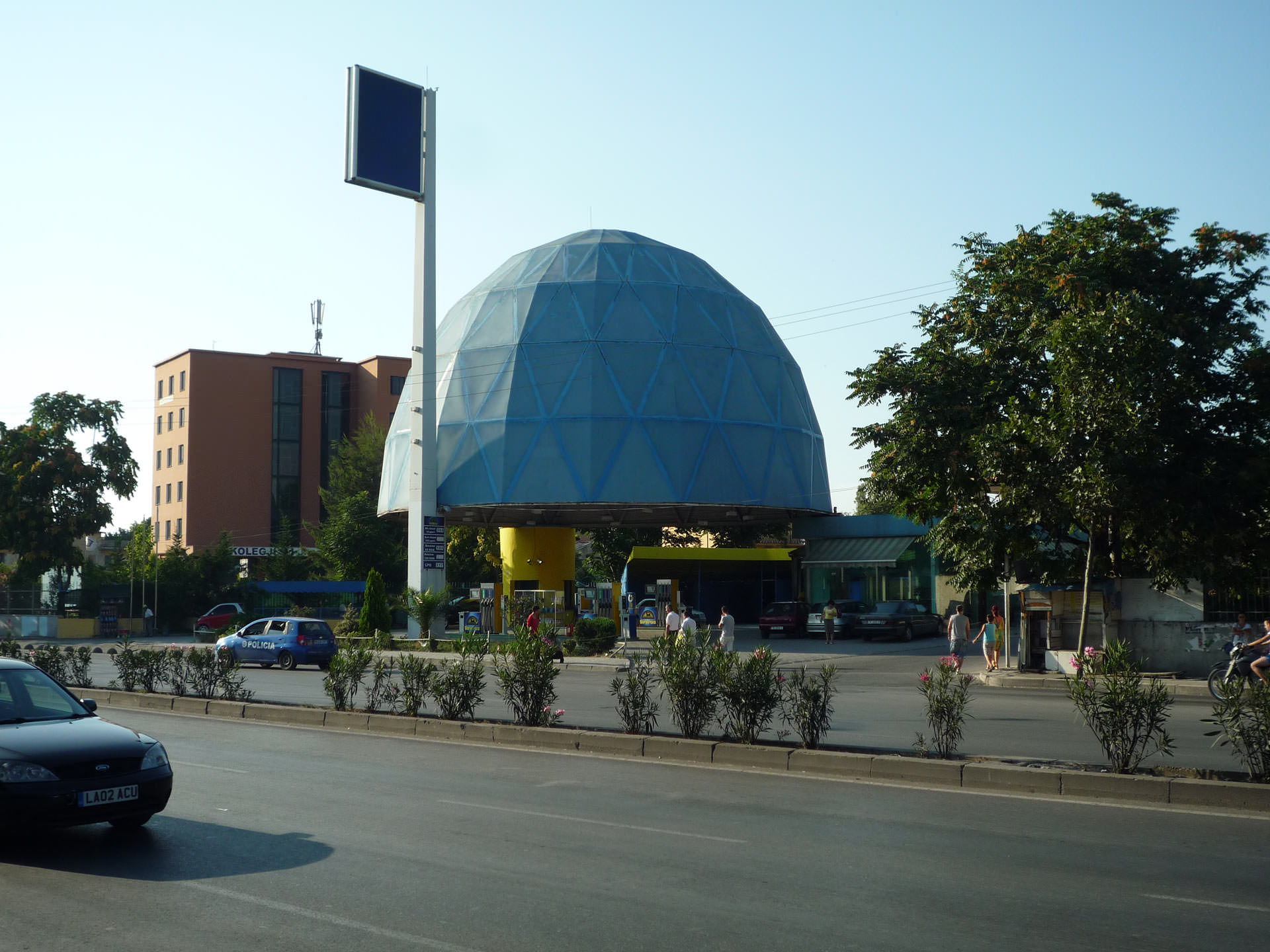
Petrol Stations by 51N4E | A Monumental Approach to Public Space in Tirana

**This article was originally published on uncube blog - building of the week on October 10, 2013.

PUMPING IT UP IN TIRANA
ALBANIAN PETROL STATIONS BY 51N4E

1 | 10: BUCKMINSTER FULLER LIVES! ONE OF THE 51N4E-DESIGNED PETROL STATIONS IN TIRANA, WHICH COMBINE BOLD ARCHITECTURAL FORMS WITH SENSITIVE URBAN PLACEMAKING. ALL PHOTOS: ANDREAS RUBY.

The chance to build a petrol station is a rare opportunity for an architecture firm, since the handful of multinationals controlling the market tend to prefer blanketing the globe with their standard corporate readymades. Hence it was quite a treat for the Belgian office 51N4E to be asked to design two of them in Tirana. Andreas Ruby took a road trip to investigate.

Albania is one of the least likely places in Europe where you would expect to come across contemporary architecture. As a totalitarian regime in the mould of Stalinism, and later Maoism, Albania existed in complete isolation during the cold war and was sealed tight even against its neighbouring Eastern block countries. When the regime collapsed in 1991, the country stumbled straight into a neoliberal economy and it wasn’t long before the ensuing culture shock was reflected in the transformation of urban developments.

Private vs. Collective

After decades of forced collectivism, people understandably jumped on the bandwagon of late-capitalism. Private ownership became de rigeur: my house, my garden, my car. In contrast, the idea of public space was inexorably contaminated by memories of military parades and choreographed party rallies. As a result, over the past twenty years most new urban developments in Albania focus almost entirely on satisfying the spatial needs of private investors – and their mantra is: the only good space is sellable space. Nevertheless, below the radar of this raw real estate rationale, Tirana has still managed to develop a great culture of public space, one that is embedded in the everyday activities of its citizens and the city’s infectious street life.

In view of commercial urban inhibitions, 51N4E saw their petrol station designs as opportunities to generate public space as contraband, a facility that helps to fuel the city as well as its automobiles. In both designs, the architects have realised this strategy in two quite different ways.

The Kastrati Station

THE KASTRATI’S CANTILEVERED CANOPY “EVOKES THE HEROIC PROWESS OF MODERNIST ENGINEERING” AND SITS ASTRIDE A BRICK “MONUMENTAL DRIVE-IN CURVE” THAT “RECALLS THE CARRIAGE DROP-OFF POINT OF A BAROQUE CASTLE.”

In the Kastrati filling station (Kastrati being a common Albanian surname), completed 2010, 51N4E have pulled the street space over onto the plot of the filling station, much as you might drag the carpet of your living room into the hallway. A long wall of yellowish bricks leads from the road in a generous concave curve deep into the plot and out again to the road on the other side. Where the wall meets the far end of the plot, a massive blue steel roof cantilevers breathtakingly back towards the street, sheltering the petrol pumps placed underneath.

The resulting set-up is a careful blend of unique spatial scenarios: the monumental drive-in curve recalls the carriage drop-off point of a baroque castle, the roof evokes the heroic prowess of modernist engineering and the long brick wall (a material rarely used in Tirana) is reminiscent if Dutch town squares. 

Indeed the Kastrati station gives less of a feeling that you are at a petrol station souped up with some special spatial effects, than one of being in an urban square where you can also happen to buy petrol. This scenario is enhanced by an inviting opening in the wall, which leads to an informal market at the back of the block. A conventional petrol station would suck you in from the street and spit you out again into the traffic after refuelling, but 51N4E’s Kastrati station makes you actually curious to explore the urban fabric hidden behind.

The Europetrol Station

THE PETROL PUMPS UNDER THE FACETED DOME. “STANDING BENEATH IT, YOU GET AN INTENSE SENSATION OF BEING SHELTERED, A FEELING YOU MIGHT EXPECT FROM A CHAPEL...”

The same kind of urban reasoning drives the design of 51N4E’s Europetrol station (2005-2006) situated along the biggest approach road to Tirana from the airport. Held by three supports, a monumental steel cupola floats above a small clutch of petrol pumps. Standing beneath it, you get an intense sensation of being sheltered, a feeling you might expect from a chapel perhaps, but not something as banal as a petrol station. It is a calculated collision of scales and atmospheres indicating that, once again, this project is about transforming a functional environment to provide asylum for a public space that otherwise would have no place in the city.

Europetrol’s layout also clearly departs from conventional filling stations. It is situated on a corner site and the small service and café building is located against the small perpendicular road, providing an actual street façade – petrol station buildings are almost always situated away from the road – and a small car wash structure marks the far end of the plot. Together, they frame a small square crowned and accentuated by the tall, hovering cupola that puts the finishing touch to the estrangement from the normal iconography of this program. As you drive by, the structure clearly looks nothing like a petrol station, rather, an inconspicuous monument to public space, which happens to contain a filling station as well.

– Andreas Ruby is the co-founder of
Ruby Press specialising in books on architecture, art and other cultural practices.


************************************************************


Oct 11, 2013

SQFT | Matching Pop-ups with Idle Spaces


The online platform SQFT [square foot] connects local creative entrepreneurs/start-ups to temporary/short-term leases, which would activate underutilized spaces and revitalize the neighborhood by bringing a diverse array of pop-up experiences to attract people and businesses - commercial development as well as employment opportunities - as a strategy for long-term urban planning processes.

New Ideas in Old Spaces:

Idle Spaces // Pop-up City // Communities in Transition //
Idle Workforce // Business Growth // Online Commerce //


Would something like this work in your neighborhood?
If you know of or have been part of similar community based initiatives. let us know.


*********************************************************************

[Re]Visiting the Favelas | [Re]Painting Urbanism

Haas & Hahn are back at it in Rio and they want your help.

Eight years after painting the first façade, see how the project has evolved:

Check out their Kickstarter campaign!!


*****
Maybe we should take this opportunity to open back up this conversation 
in regards to the city of Tirana. 

What is the shelf life of painting urbanism? 

What are the urban, social and economic implications [short-term], 
and the lingering effects on future city growth models?


******************************************************************

Oct 8, 2013

Support & Donate!!

Take a moment to support and donate to these upcoming projects.

1. Albanian Film Week - Second Edition on Indiegogo:


Albanian Film Week- 2nd edition, is under way, on November 8th-14th, 2013 in New York City.This year, our ceremony red carpet will occur at SVA theaters.
After a great inauguration last year, dedicated to 100th year anniversary of independent Albania, we are doing the 2nd year- different, bigger and better..

In ordered to reach/finish some of our goals, we need Help, and therefore we have created an online funding campaign where anyone can contribute any amount!
If you can, please make a contribution, no limits, and even better if you can share it with your friends and family, we would really appreciate it! Event RSVP.

2. Mobile Library for 1500 Children in Albania on GlobalGiving:


Imagine children who do not have books or the internet or toys! Children over six years old attend school, care for animals or do housework. The Mobile Library provides a monthly service to improve children's literacy and knowledge and love of reading in 45 rural communities. Teachers loan books to improve their lessons. In addition games, competitions and activities are provided for the 1,500 children living in the isolated and deprived mountainous communities in northeast Albania. 

*************************************************************************

Oct 4, 2013

Featured Event | Circus A Way Of Life

European Cultural Heritage Days in Albania!


‘‘Circus a Way of Life’’ will take place tomorrow, October 5th, at 6:00-7:30pm, between PEDONALJA (Tirana's only pedestrian street) and the PYRAMID. Led by the French theater company Capillotractee Cie’, 12 young artists (ages 15-18) will provide a unique show that includes acrobatics, juggling, dance performance, pantomimes, pyrotechnics and drama, music, etc. 

The project's main goal is to support the homeless youth and to get them more involved in creative activities. Also, of importance is promoting a civic attitude and awareness toward street art and performance in order to revitalize the city. 

This event is organized by Art Kontakt in collaboration with the Don Bosko Center and supported by the 2007-2013 Cultural Program of the European Commission.
*****
Nesër, më datë 5 Tetor, nga ora 18.00-19.30 do të realizohet tek PEDONALJA dhe PIRAMIDA eventi i spektaklit të rrugës ‘‘Circus a Way of Life’’.  12 Artistë të rinj të moshës 15-18 vjec, të udhëhequr nga kompania franceze e teatrit Capillotractee Cie’ , do të ofrojnë një spektakël të veçantë që përfshin akrobaci, zhongleri, dance performancë, pantonime, piroteknikë dhe aktrim, muzikë, etj. 

Projekti ‘‘Circus a Way of Life’’ synon të motivojë dhe mb
ështesë fëmijët e rrugës, të rinjtë e talentuar që ndodhen në kushte të vështira social ekonomike të meren me aktivitet krijues. Gjithashtu projekti synon të përhape një mendësi qytetare që orientohet drejt artit dhe spektalit të rrugës për të gjallëruar rrugët dhe sheshet tona. 

Ky event organizohet nga Art Kontakt në bashkëpunim me Qendrën Don Bosko dhe mbështetet nga Programi i Kultures 2007-2013 i Komisionit Europian.

via SPK

******************************************************************

Sep 27, 2013

Featured Exhibit | 100km Art - Tirana/Shkodra Public Art Parcours

What role plays #publicart in understanding & at the same time challenging 
the dialog between man and land? 
Built vs. natural, preserving vs. destroying, 
private vs. public, domesticity vs. digital scapes?

FIND OUT THIS SUNDAY!!


Tirana/Shkodra Public Art Parcours 
An art exhibition on the road between Tirana and Shkodra.

Bus Tour starts at 11:00 a.m, Sunday September 29th 2013,
at Mother Tereza Square, in front of the National Archeological Museum. 
The tour is free and will guide the public through the art work
s 
on the road between Tirana and Shkodra. 
***
Tiranë/Shkodër Përshkimi i Artit Publik 
Një ekspozitë arti në rrugën që lidh Tiranën dhe Shkodrën.


Autobuzi niset në oren 11 të mëngjesit, të dielën më 29 Shtator 2013, 
në sheshin Nënë Tereza, përballë Muzeut Arkeologjik Kombëtar. 
Autobuzi është falas dhe do ta drejtojë publikun në veprat e artit përgjatë rrugës Tiranë- Shkodër.

***
artists//artistët:

Nikolin Bujari
Kueng Caputo
Ledia Kostandini
Matilda Odobashi
Guadalupe Ruiz
Susanne Schär & Peter Spillmann
Studio 203 & Romeo Kodra
Johannes Willi

curators//kuratorët:

Adela Demetja 
Eveline Wüthrich
‘‘ 100km Art- Tiranë/Shkodër Përshkimi i Artit Publik është një bashkëpunim mes artistëve bashkëkohor shqiptar dhe zviceran. Artistët janë ftuar për të punuar mbi një projekt të posaçëm (site specific) në rrugën mes kryeqytetit të Shqipërisë, Tiranës, dhe qytetit të Shkodrës, në kufi me Malin e Zi.

Ndonëse Tirana është kryeqyteti i artit dhe krijimeve artistike, Shkodra është qyteti më i vjetër dhe më i madh në veri të vendit me një tradite tepër të rëndësishme në art, muzik dhe film. Rruga e cila lidh këto dy qytete dhe e cila të drejton edhe për Kosovë, është ndër akset kryesore, e perdorur nga shumë njerëz në lëvizjet e tyre të përditshme.
Përveç disa monumenteve të bëra kryesisht për qëllime patriotike dhe çështje identiteti, siç janë statuja të figurave historike apo simbolika të ndryshme të këtij tipi, të cilat janë të vendosura pothuajse të gjitha, në qëndër të qytetit, arti publik në Shqiperi është me pakicë.
Jo vetëm duke lënë hapsirat e muzeve apo galerive, por edhe qytetin vet, projekti synon të shkojë përtej mureve fizike apo simbolike qofshin, për tu përballur me një territor dhe një publik më të gjërë. Një ndër synimet kryesore të ekspozitës ishte edhe bashkimi i artistëve shqiptar dhe zviceran të cilët në punët e tyre kanë fokus edhe artin publik. Të dy kahët kanë nevojë për njëri-tjetrin: artistët zviceran e kanë eksperimentuar artin në hapsira publike shpesh - një fenomen i zakonshëm në Zvicer dhe me një traditë të gjatë - ndërsa artistët shqiptar janë të familjarizuar me ambjentin dhe rrethanat në Tiranë dhe Shkodër.

Një film dokumentar nga Olsi Hoxha do japi nje këndvështrim të ekspozitës për ata që sdo të mund të jenë prezent. 

Ekspozia është organizuar nga Tirana Art Lab - Qëndër për Artin Bashkohor me mbështetjen e Pro Helvetia-s.
**********

‘‘ 100km Art – Tirana/Shkodra Public Art Parcours is a collaboration of Albanian and Swiss contemporary artists. The artists have been invited to realize site specific works on the road between the capital city of Tirana and the city of Shkodra, bordering on Montenegro. Whereas Tirana is today’s creative and artistic capital, Shkodra is the oldest and biggest city in the north of the country with an important tradition in art but also music and film. The street connecting the two cities and leading to Kosovo is a main axe, driven by many people on their everyday ways.

Besides some historical monuments as signs of identity and statues of national heroes mostly situated in the city centre, there’s not much art in public space in Albania. Not only leaving the inside space of the museum but also the actual city, the project is about going one step further and engaging with a new territory and addressing a different public.
Bringing Swiss and Albanian artists together that address public space in their work is the main goal of the exhibition. Both parts are needed, as the Swiss artists are experienced with art in public space – a common phenomenon in Switzerland with a long tradition – whereas the Albanian artists are familiar with the landscape and circumstances in Tirana and Shkodra.
A documentary of the exhibit will be filmed by Olsi Hoxha.

The exhibition is organized by Tirana Art Lab – Center for Contemporary Art and generously supported by Pro Helvetia.

********************************************************************